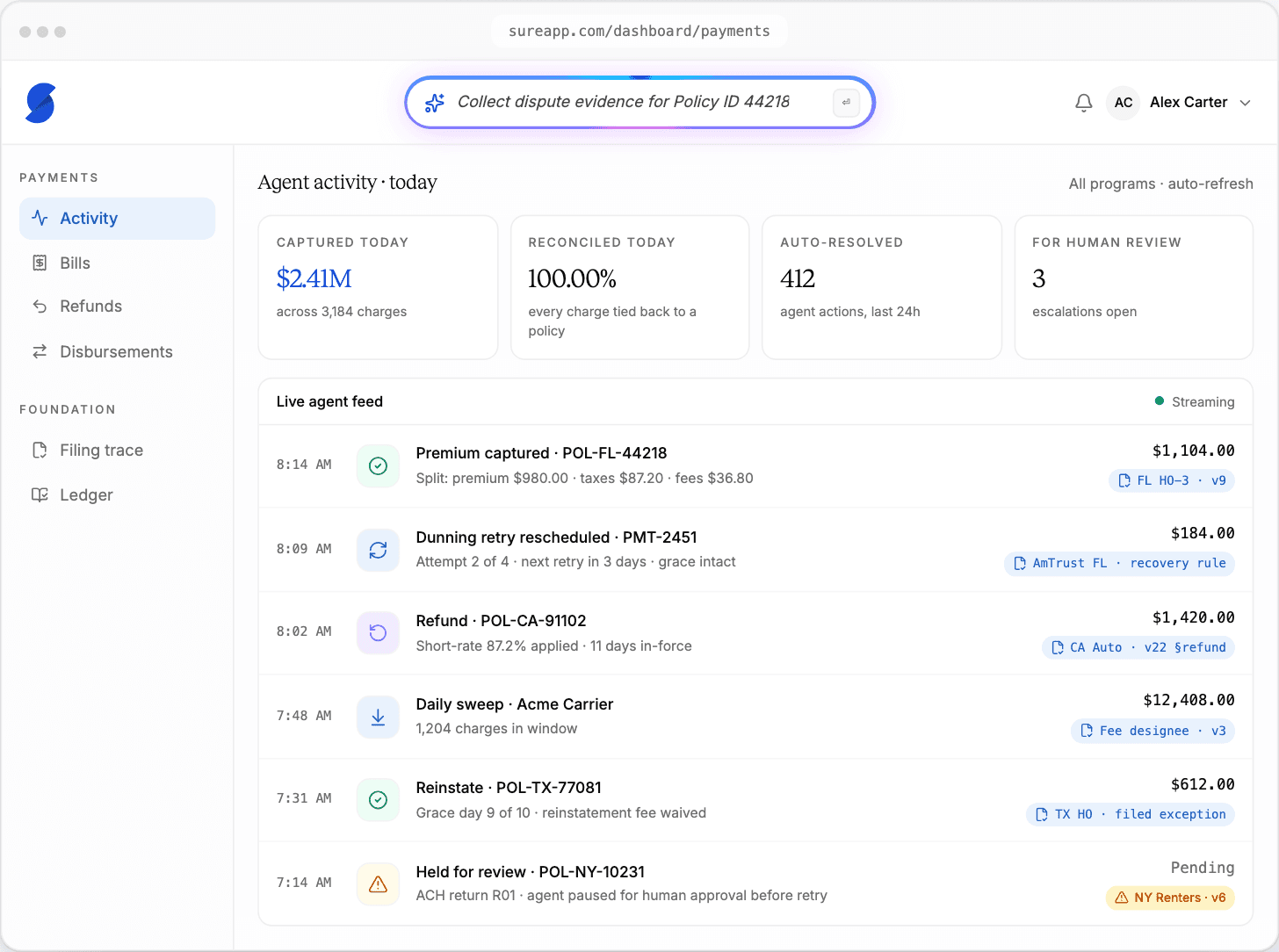
Insurance payments infrastructure has historically been an afterthought. Carriers bolt on general-purpose payment processors, then spend years wiring them to policy administration systems, filing rules, and state-specific remittance requirements. The result is a patchwork of manual reconciliation, compliance gaps, and finance teams buried in spreadsheets.
Sure built something different. A payments engine that starts from the insurance filing and works outward.
When payments don't understand insurance
Most payment platforms were designed for e-commerce or SaaS. That world of charges, refunds, and subscriptions they handle well. But insurance runs on different mechanics: installment billing tied to a 12-month policy term, a mid-term adjustment in California that triggers a different refund calculation than the same change in Texas, commission disbursements that must align with the earned premium schedule defined in a carrier's filing. Generic platforms have no concept of any of it.
This mismatch forces insurance companies into one of two paths: build a custom financial layer from scratch (expensive, slow, error-prone) or accept the limitations of generic tools and absorb the operational cost of making them work.
Sure eliminates that choice entirely.
How it works: Three pillars of filing-native payments
1. Premium Collection and Billing Schedules
Every billing schedule Sure generates is derived directly from the filed rate and term structure. Installment plans, grace periods, late fees, and minimum-earned-premium rules are not configured manually. They are computed from the policy's filing parameters.
This means a carrier launching in a new state does not need to reconfigure their billing engine. The rules come from the filing, and Sure enforces them automatically.
Supported collection methods include ACH, credit and debit cards, and direct bill. Payment credentials are vaulted, ensuring PCI compliance without carriers handling raw card data.
2. Refunds and Mid-Term Adjustments
Policy changes (endorsements, cancellations, reinstatements) trigger financial consequences. Sure's engine calculates the correct refund or additional premium owed based on the filed short-rate or pro-rata table, executes the transaction, and updates the sub-ledger in a single atomic operation.
Nothing requires manual intervention or spreadsheet reconciliation, and there's never a gap between what the policy says and what the bank account reflects.
3. Disbursements
Paying out commissions, net premiums, and fees to the right parties at the right time is where most insurance payment stacks break down. Sure's disbursement engine maps every inbound dollar to its outbound destinations based on the contractual and filing-defined splits.
Commission schedules, MGA fee arrangements, and carrier net remittances are all computed automatically. Sure's internal payout engine handles the orchestration, providing itemized reconciliation reports that break down each payout to the individual charge level. Carriers see exactly which policies, terms, and transactions comprise every settlement.
Payments AI: When your financial engine can read the policy
Payments AI is the layer that makes Sure's financial engine autonomous. It is not a chatbot or a dashboard widget. It is an agent-callable system that can:
- Predict and prevent payment failures before they generate policyholder friction
- Auto-resolve billing discrepancies by cross-referencing policy state, payment history, and filing rules
- Optimize collection timing based on historical payment behavior and lapse-risk scoring
- Execute complex financial operations (batch refunds, commission true-ups, multi-carrier settlements) that would otherwise require manual finance team intervention
The difference between Sure and every other insurance payment platform: Sure's AI layer does not just move money. It understands why the money moves, where it should go, and what the filing says about how it gets there.
Who it's for
| Role | What They Get |
|---|---|
| Carriers | Filing-compliant billing and remittance without custom integrations |
| MGAs | Automated commission accounting and multi-carrier reconciliation |
| Embedded partners | White-label payment collection with zero insurance domain expertise required |
| Agents | Real-time policyholder billing visibility and self-service payment management |
The technical foundation
Sure operates as both a Payment Facilitator (PayFac) and an Integrated Payments (IP) provider, giving partners flexibility in how they onboard. The sub-ledger architecture maintains a real-time, auditable record of every financial event tied to its originating policy transaction.
Key infrastructure details:
- PCI Level 1 compliant via tokenization. Raw payment credentials never touch Sure's application layer.
- Real-time ledger updates. Every premium payment, refund, and disbursement is reflected in the sub-ledger within seconds, not batched overnight.
- Multi-currency and multi-entity support. Sub-merchant accounts can be provisioned per program, per carrier, or per MGA depending on the fund-flow architecture.
- API-first design. Every financial operation is callable via API, enabling programmatic billing, collections, and payouts from any policy administration or distribution platform.
Get started
Sure's payments infrastructure is live and processing. If your organization is building or modernizing insurance programs and wants financial operations that understand your filing from day one, talk to our team.
FAQ
Does Sure handle both direct bill and agency bill? Yes. Sure supports direct bill (carrier bills the policyholder) and agency bill (agent collects and remits to carrier) flows. The billing configuration is determined by the program structure and filed plan of operation.
How does Sure handle state-specific billing regulations? Billing rules (grace periods, late fees, cancellation refund methods, minimum earned premium) are derived from the filed rate and rule pages. When a program operates across multiple states, Sure applies the correct rule set per policy based on the policy's jurisdiction.
Can carriers use their own payment processor? Sure operates as both a Payment Facilitator (PayFac) and an Integrated Payments (IP) provider. In PayFac mode, Sure manages the full payment stack. In IP mode, Sure can integrate with a carrier's existing processor while still providing the insurance-native ledger and billing logic.
What reporting and reconciliation tools are available? Sure provides real-time sub-ledger access, settlement reports, and transaction-level audit trails. Every financial event is tied to its originating policy, term, and coverage, making regulatory reporting and financial audits straightforward.
Is premium financing supported? Sure's billing architecture supports installment plans and flexible payment schedules as defined by the filing. Integration with third-party premium finance companies is supported through Sure's API layer.
How does Sure handle disputes and chargebacks? Sure monitors disputes in real time and provides automated notifications when a chargeback is initiated. The system correlates each dispute back to the originating policy transaction, enabling fast resolution with full audit context. Dispute outcomes are reflected in the sub-ledger automatically.
How does payout reconciliation work? Every payout is broken down to the individual charge level. Reconciliation reports show exactly which policies, premium installments, and fee components make up each settlement, so finance teams can trace any dollar to its source without manual lookup.